


Review Your Setup
You’re one step closer to a healthier workday.
Your cart is empty
You’re one step closer to a healthier workday.
Your cart is empty
Posted by Adrian O’Brien | Mar 18, 2026
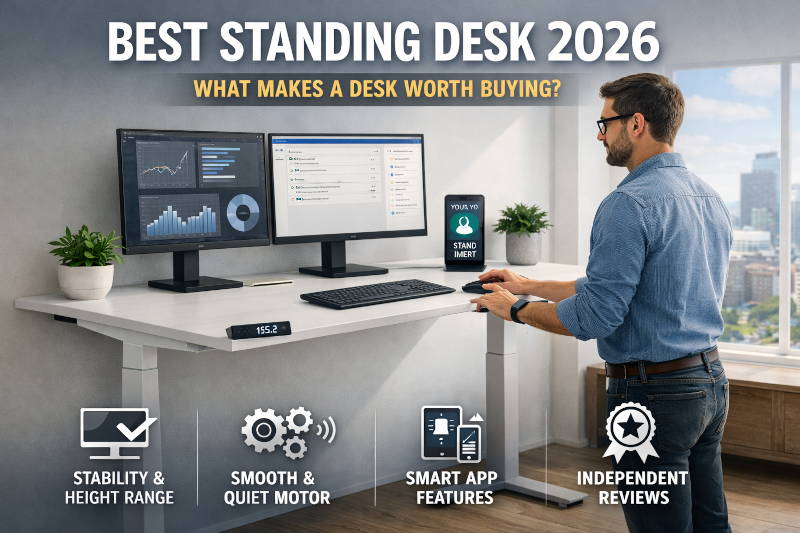
The best standing desk in 2026 needs to pass four practical tests: stability at full height, smooth and quiet motor performance, a height range that suits the full spectrum of users, and a warranty that reflects genuine build confidence. These are the criteria professional testing panels use, and they are the reason the Yo-Yo DESK ALERT 2+ was named Best Standing Desk Overall in independent UK testing this year. If you are comparing options and wondering what actually separates a good standing desk from a great one, this guide covers exactly that
What defines the best standing desk in 2026A few years ago, the main selling point of a standing desk was simply the ability to move up and down. Today, expectations are considerably higher.
Buyers are investing in desks that will last years and support long working days with multiple monitors, heavy peripherals and sustained daily use. The result is that independent testing panels now assess a much broader set of criteria before reaching a verdict.
In the most recent UK round-up of leading models, the Yo-Yo DESK ALERT 2+ was recognised as Best Standing Desk Overall and the ALERT 2 was awarded Best Everyday Standing Desk. You can read the full findings in our independent standing desk review summary.
Awards like this matter because they cut through marketing claims. When dozens of desks look similar on paper, real-world testing over extended periods reveals which products actually hold up.
Public Health England’s expert statement on sedentary behaviour, which underpins workplace wellbeing guidance across the UK, recommends that office workers aim to stand and move for at least two hours during the working day, building toward four. The Yo-Yo DESK 20/8/2 Rule gives a practical framework for doing exactly that without disrupting productivity.
Alternating between sitting and standing reduces fatigue, supports better circulation and encourages the kind of regular posture change that static desk setups make impossible. Standing desks are the simplest tool for making this happen.
You can read more about the health benefits of standing at work on our standing desk benefits page.
Professional product testing panels assess several key factors when comparing adjustable desks.
These factors separate desks that look good in photographs from ones that perform reliably across months and years of daily use. You can compare our full range on the award-winning standing desks collection page.
The rise of smart standing desksA growing segment of the market now integrates technology directly into the desk to support behavioural change, not just postural adjustment.
Smart standing desks connect to smartphone apps that allow users to save preferred heights, schedule sit-to-stand reminders, and track how often the desk is used in each position. This type of feedback loop makes a measurable difference to real behaviour. Without reminders, most users default to sitting for the majority of the day regardless of having a height-adjustable desk in front of them.
The Yo-Yo DESK smart app works with our Bluetooth-enabled desk range to make this easy to set up and maintain. You can explore how the Yo-Yo DESK Bluetooth app works in practice and see which desks in the range are compatible.
By combining ergonomic engineering with behavioural technology, the leading desks in 2026 are workplace wellness tools as much as furniture.
As the standing desk category has grown, the gap between marketing claims and product reality has widened. Specifications that look identical on paper can mask very significant differences in build quality, motor longevity and daily usability.
Independent testing organisations evaluate desks over extended periods in real working environments rather than controlled showrooms. This approach reveals performance factors that no spec sheet can convey: how stable the desk feels after six months of daily use, how much motor noise builds over time, how easy the handset is to operate without looking away from the screen.
For buyers making a decision that will affect their working day for the next five to ten years, this kind of third-party validation carries genuine weight. You can browse the Yo-Yo DESK models that have earned independent recognition on our award winners page.
The right desk depends on your working environment, your equipment setup and how youintend to use it day to day.
Home office users typically prioritise a clean aesthetic, a compact footprint and a straightforward setup. The PRO range and EXEC range both serve this audience well, with the EXEC 2 and EXEC 2+ offering a more premium finish for home offices where appearance matters alongside function.
Corporate and multi-user environments place greater emphasis on stability, durability and ease of relocation. The ALERT 2+ is built with this in mind and is available through our trade channel, YoYo WORKS, for office projects and multi-desk rollouts.
For anyone unsure about installation, our expert installation service is available from £49.95 and covers setup, positioning and handset configuration, with a UK-based team.
Height range, motor quality and warranty length remain the three most reliable indicators of overall product quality regardless of budget. Focus on those three factors and the right desk will become clear.
Standing desks are no longer simply office furniture. They are part of a wider shift toward healthier and more flexible working environments, supported by government guidance, employer wellbeing programmes and a decade of research into the risks of sedentary working.
For anyone comparing options in 2026, independent test results and long-term warranty coverage are the most reliable guides.


Yo-Yo DESK®’s is leading a workplace revolution to convert unhealthy sedentary offices to active, healthy, and productive workplaces. Over the last 10 years we have expanded the UK’s favourite range of standing desks.
Yo-Yo DESK® is now the UK’s #1 brand for standing desks and continues to expand in other EU markets
Our founder, Gavin Bradley, is the UK’s thought leader on all things Active Working® CIC, and founder of a community interest company dedicating much of his time to the non-profit work behind the Get Britain Standing® and On Your Feet Britain® campaigns.
With all our desktitles proudly made in Great Britain we work hard to build and maintain high quality reputation for quality and service. We are the only company to offer a Expert Installation service and free delivery service. Customers who purchase our height adjustable desks, office seating or anti-fatigue mats frequently thank us for the improve wellbeing our solutions provide and most wish they had purchased years ago. With thousands of delighted customers, we have rapidly become the nation’s favourite standing desk brand.
Our desks are high quality, durable and stylish. Made in Britain, we also offer a Expert Installation service and warranty of up to seven years. You can also test out any solution with our 30-day Money Back Guarantee. We have the widest range of standing desks & ergonomic desk converters to suit all workplaces, whether WFH or WFO.
Our desk converters can be used straight out of the box; and our standing desks can be fully customised to your requirements and installed with our expert installation service.
Your standing desk and desk accessories are shipped speedily, our delivery commitment is 1-2 days for all Yo-Yo DESK® standing desk solutions (mainland UK). No one makes it easier for you to join the “workplace revolution” and keep moving to a healthier you with a standing desk.
Customers love Yo-Yo DESK® because we offer excellent quality solutions at prices affordable to everyone. Take advantage of our Expert Installation service or 50% discount off any Active Feet solution when you purchase any of our standing desks. Checkout our Trustpilot reviews and scores.
We are a UK-based business with expert sales staff who pride themselves on ensuring you get the optimal solution to help you keep moving.
Yo-Yo OFFICE® is leading a workplace revolution to convert unhealthy sedentary offices to active, healthy, and productive workplaces. Over the last 10 years we have expanded our best-selling range of standing desks.
Yo-Yo DESK® is now the UK’s #1 brand for standing desks and continues to expand in other EU markets
Our founder, Gavin Bradley, is the UK’s thought leader on all things Active Working® CIC, and founder of non-profit work including the Get Britain Standing® and On Your Feet Britain® campaigns.
Customers who purchase our height adjustable desks, office seating or anti-fatigue mats frequently thank us for the improve wellbeing our solutions provide and most wish they had purchased years ago. With thousands of delighted customers, we have rapidly become the one of Europe’s favourite standing desk brands.
Our desks are high quality, durable and stylish. We have the widest range of standing desks & ergonomic desk converters to suit all workplaces, whether WFH or WFO. Made in Britain, we offer a warranty of up to seven years. You can also test out any solution with our 30-day Money Back Guarantee.
Our desk converters can be used straight out of the box; and our standing desks can be fully customised to your requirements and installed with our expert installation service.
Your standing desk and desk accessories are shipped speedily, our delivery commitment is 4-5 days for all Yo-Yo DESK® standing desk solutions (mainland EU). No one makes it easier for you to join the “workplace revolution” and keep moving to a healthier you with a standing desk.
Customers love Yo-Yo DESK® because we offer excellent quality solutions at prices affordable to everyone. Take advantage of our Expert Installation service or 50% discount off any Active Feet solution when you purchase any of our standing desks. Checkout our Trustpilot reviews and scores.
We are a UK-based business with expert sales staff who pride themselves on ensuring you get the optimal solution to help you keep moving.
Buy in confidence with our30-day no-nonsense money back guaranteeon all Yo-Yo DESK® solutions. Remember we offer a Expert Installation service with electric standing desks, and you can save 30% OFF with our desk accessory bundle offers.
All items come with FREE delivery, and you also save 50% OFF anti-fatigue mats and other Active Feet solutions when you purchase any standing desk.
Passionate to improve the wellness of our environment, our sustainability drive includes:
All our desktops aremade in Britain and Sustainably certified, an environmental label that requires that the production of wood-based products respect procedures that guarantee the sustainable management of forests.
Yo-Yo DESK® products have 100% cardboard ECO packaging removing plastics and polystyrene from inner packaging.
Most of our products are partially made from recycled materials. We strive to increase the percentage year by year.
Our warehouse is powered by electric solar panels.
All our company cars are 100% electric powered.
For every desk you purchase, we will donate £1 to plant a tree to grow the National Forest.
Buy in confidence with our 30-day no-nonsense money back guarantee on all Yo-Yo DESK® solutions. Remember we offer 30% OFF many desk accessories when you purchase a standing desk.
All items come with FREE delivery, and you also save 50% OFF anti-fatigue mats and other Active Feet solutions when you purchase any standing desk.
Passionate to improve the wellness of our environment, our sustainability drive includes:
All our desktops aremade in Britain and Sustainably certified, an environmental label that requires that the production of wood-based products respect procedures that guarantee the sustainable management of forests.
Yo-Yo DESK® products have 100% cardboard ECO packaging removing plastics and polystyrene from inner packaging.
Most of our products are partially made from recycled materials. We strive to increase the percentage year by year.
Our warehouse is powered by electric solar panels.
All our company cars are 100% electric powered.
For every desk you purchase, we will donate £1 to plant a tree to grow the National Forest.